The Social Media Lawsuits Got the Problem Right. They're Getting the Solution Wrong.

Everyone is calling this social media's big tobacco moment. The attorneys general lawsuits, the congressional hearings, the parents and teenagers struggling. The comparison feels apt. But if we're serious about the tobacco analogy, we should actually look at what worked. Because the answer isn't what most people think.
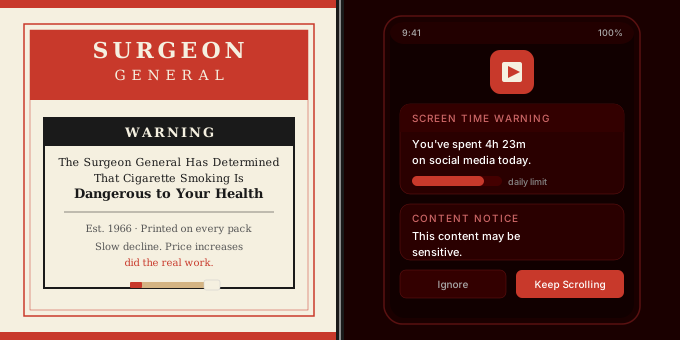
For decades, public health efforts focused on awareness campaigns. Warning labels, anti-smoking ads, educational programs. They helped at the margins. But the research is unambiguous about what actually moved the needle: price increases. According to a landmark study by Chaloupka and Warner for the National Cancer Institute¹, a 10 percent increase in cigarette prices reduced adult demand by 3 to 5 percent, and the long-run effect was roughly double the short-term impact. Warning labels didn't make tobacco companies less predatory. Making smoking structurally expensive did.
We're at the same inflection point with social media. Screen time warnings and content moderation mandates are the warning label equivalent. Visible, well-intentioned, and insufficient. We need the equivalent of the price increase: a structural intervention that makes the current behavior economically untenable.
That intervention is audience portability, the idea that creators and users should be able to take their audiences and connections with them when they leave a platform, rather than having those relationships held hostage by the platform they built them on.
The Problem Starts With the Incentives
A million followers on Instagram or TikTok doesn't mean what it used to. Algorithm changes have gutted organic reach, and if you get demonetized, banned, or simply decide to leave, those followers don't come with you. They were never really yours. And for users it's even worse. Infinite scroll, autoplay, algorithmically tuned feeds built to trigger emotional responses. These aren't accidents, they're the product. The anxiety, the depression, the inability to put the phone down are direct outputs of a system working exactly as designed.
The Problem Isn't Time Spent. It's Who Benefits From It.
I spent 13 years at Facebook. I know many of the people running these companies. They're not villains. They're smart, well-intentioned people operating inside a system that produces bad outcomes because of the underlying business model. Ad-driven platforms are optimized for time on platform, and every product decision flows from that.
The problem is that what's good for the platform and what's good for the creator are fundamentally different things. MrBeast, the biggest creator on YouTube, loses money on his videos. His actual business is selling chocolate bars and burgers, revenue YouTube has no stake in. YouTube needs watch time. MrBeast needs sales. Those aren't the same thing.
Most creators face the same tension without MrBeast's resources to work around it. They need their audience to do something: buy a ticket, start a subscription, show up somewhere. Platforms have no incentive to help with any of that, and actively suppress it when it takes people off-platform. That's why creators put links in comments instead of posts. Everyone knows the platform will throttle their reach if they try to send people elsewhere.
The misalignment runs the same way for users. What's good for the platform is time spent. What's good for the user is something useful actually happening with that time. Those two things aren't the same, and the platform optimizes for one of them.
That's the misalignment on both sides. And lock-in, the inability for creators or users to take their relationships anywhere, is what makes it permanent.
Portability Is the Only Real Check on Platform Power
This is the same dynamic the tobacco price increases broke. When the cost of the harmful behavior goes up, the behavior changes. Right now platforms pay no cost for extracting value from creators and users because neither can leave without losing everything they built. Audience portability changes that calculus.
If your audience relationship lives on the platform's servers, governed by their algorithm, subject to their policies, the platform holds all the leverage. It can throttle your reach, change its monetization terms, or make your content less visible, and your only alternative is to start over somewhere else from scratch.
The same is true for users. Leaving Facebook or Instagram doesn't just mean finding a new app. It means losing touch with everyone you've connected with there. Your social graph is held hostage by the platform. That captivity is what allows platforms to keep optimizing for compulsion rather than genuine value. If users could leave and take their connections with them, platforms would have to compete on whether their product is actually good for the people using it.
Audience portability breaks that leverage for both. A platform that knows creators and users can leave and take their communities with them has to compete on the quality of what it offers. The exit being real is what makes the incentives align.
What This Actually Looks Like, And How Simple It Is
This isn't a hard technical problem. Every platform already has email addresses on file for every creator and every user. For creators, enabling portability is essentially just allowing them to export that list. For users, it means being able to export their social graph, the list of creators and people they follow, so they can reconnect on whatever platform they move to. The data already exists. The technical lift is trivial.
Which is also why it cuts through the regulatory mess so cleanly. Section 230 liability reform requires determining when platforms become publishers. Age verification raises privacy concerns. Content moderation mandates run into First Amendment complications. Any meaningful advertising regulation would require rewriting the economics of the entire internet. These are years-long legal fights with uncertain outcomes. Audience portability sidesteps all of it. You don't need to litigate what a platform is responsible for. You just need to require that the relationships creators and users build on a platform are actually theirs.
Two platforms in completely different creative verticals are already proving this out. Neither abandons algorithmic discovery. Both use feeds that help creators grow organically. The difference is what happens after that first connection. The follow is real, the communication is direct, and the audience belongs to the creator, not the platform.
Substack built its model around the idea that a writer's audience belongs to the writer. Readers subscribe via email, no algorithm mediates it. If a writer leaves, their list comes with them. The platform only survives if writers find it worth staying. That's the right incentive structure.
I co-founded Punchup Live to apply the same logic to live entertainment. Comedians and musicians can reach fans directly via email or text. Discovery happens through the feed, but once someone follows, that relationship is direct and reliable. It doesn't get throttled or buried the next time the algorithm changes. If a creator leaves, their audience goes with them. We have to keep earning that relationship every day. That's the only way it should work.
That this model works across both long-form writing and live entertainment points to something broader. Audience portability is a generalizable architecture, not a niche fix.
The Fix Is Simpler Than Anyone Is Admitting
Content moderation requirements and warning labels add friction to a system that will route around it. Just like with tobacco, awareness alone doesn't change behavior when the economics still reward the harmful one.
The fix is simple: require platforms to let creators and users export their data. No new agency, no constitutional fight, no years of litigation. Every platform already has the data. The only reason this hasn't happened is that nobody has required it.
When the exit is real, the leverage disappears. Platforms that know creators and users can leave have to compete on whether they're actually worth staying for. That's just how markets work.
Policymakers should be requiring this now. One standard, one question: can creators and users take their audiences and connections with them? The absence of that requirement is a policy choice, not a technical limitation.
And if regulators aren't moving fast enough, creators don't have to wait. The argument that most creators can't afford to leave is true today precisely because they waited too long to diversify. Every creator who starts building on a platform that gives them direct, portable access to their audience is reducing that dependency before the next algorithm change forces their hand. Platforms live and die by where creators choose to build. That leverage exists. It just needs to be used.
¹ Chaloupka, F.J. and Warner, K.E. (2000). "The Economics of Smoking." National Cancer Institute, Cancer Control Monograph. Available at cancercontrol.cancer.gov.